PostHog's email asked for less of your money. Here's why it worked.
Sumit Shinde · · 4 min read
There are only a handful of companies whose emails I open without thinking. PostHog is one of them, and that’s mostly down to Joe Black. If you work in marketing, there’s a good chance you’ve read his emails, the ones signed “Joe at PostHog”. I open every one, even when I can guess what’s coming.
So when Joe left a heart on our short LinkedIn breakdown of a PostHog email, it felt like we owed him one back. Here’s the full teardown, line by line.
The email is PostHog’s pricing announcement from July 2024, and it’s worth studying because pricing emails are where most companies lose their readers. “Exciting updates to our pricing!” usually means you’re about to pay more, and most of us have learned to read it that way.
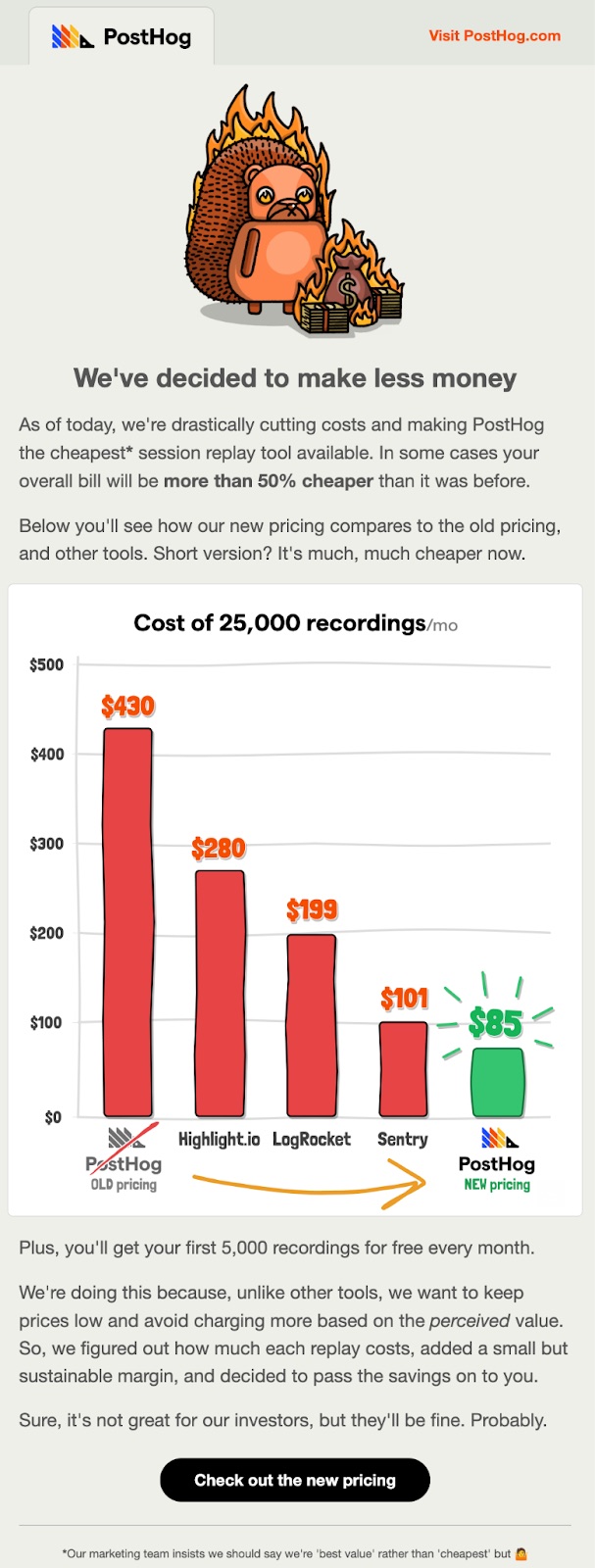
PostHog had the opposite problem. It was cutting the price of session replay, in some cases by more than half, and it needed people to believe good news. Here’s the email.
It takes about 30 seconds to read. Here’s what each part is doing, and what you can borrow from it.
It opens with a line you don’t expect
“We’ve decided to make less money.” That’s hard to skim past.
Psychologists have known since Hedwig von Restorff’s experiments in 1933 that people remember the item that breaks a pattern, and an inbox full of pricing emails is one long pattern. The hedgehog setting fire to a piggy bank helps too. You know it’s good news before you’ve read a word.
It gives you a number, then shows you
“More than 50% cheaper” tells you far more than “great new pricing” would. Then, instead of explaining, the email draws a chart: $430 a month under the old pricing, $85 now, with three named competitors in between.
The $430 matters more than it looks. On its own, $85 is just a price. Next to $430, it’s a bargain. That’s anchoring, which Amos Tversky and Daniel Kahneman described in 1974: the first number you see sets the scale for everything after it.
It tells you why
A price cut with no reason makes people suspicious. Is the product getting worse? Is the company in trouble? PostHog answers in one line: they worked out what each replay costs, added “a small but sustainable margin”, and passed the rest on.
Reasons work even when they’re thin. In Ellen Langer’s 1978 study, people let a stranger cut the photocopier queue 60% of the time when no reason was given, and 93% of the time when the reason was simply “because I have to make copies”.
It jokes about the obvious worry
“Sure, it’s not great for our investors, but they’ll be fine. Probably.”
A careful reader will wonder whether PostHog can afford this. The email says it first, and laughs. Bringing up the weak point yourself takes some of the sting out of it.
Then there’s the footnote. PostHog calls itself “the cheapest” session replay tool, and right at the bottom admits: “Our marketing team insists we should say we’re ‘best value’ rather than ‘cheapest’ but”, followed by a shrug. A small confession makes the big claim easier to believe. Elliot Aronson called it the pratfall effect: in his 1966 study, a capable person who spilled a cup of coffee came across as more likeable than one who seemed perfect.
The same moves, in a different email
You can use the same moves outside pricing. Here’s an email we wrote for a made-up coffee subscription, Fernway, telling customers it’s going to email them less. It’s good news again, but it has nothing to do with price.
Both emails work because the news is good. The same jokey tone on a price rise or a cut feature would land badly, so match the tone to the news.
We’re building Cleomail to make this part easier. Describe the email you need, and it finds the closest match among 1,000+ brand emails that already worked, this one included, then writes yours using the same psychology. Join the waitlist to try it first.